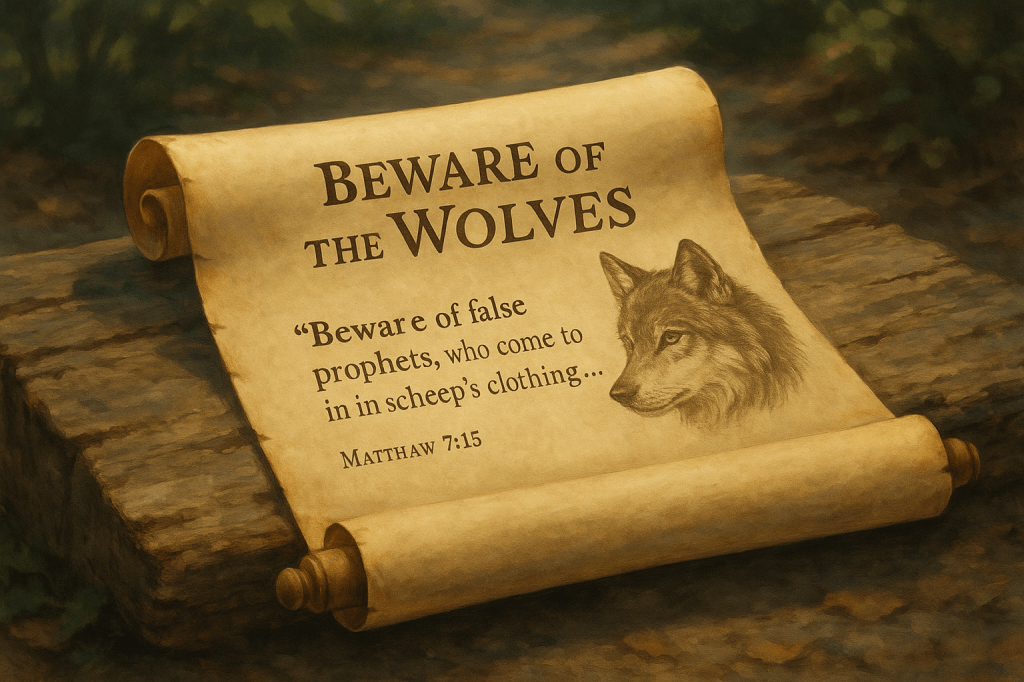
“Beware of false prophets, who come to you in sheep’s clothing…” (Matthew 7:15)
There are voices everywhere now.
Churches on every corner. Sermons in our feeds. Doctrines in our inboxes. Most of them quote scripture. Most of them sound good. But something inside begins to stir—a question, a hesitation, a knowing:
How do I tell what’s true anymore?
The answer has been there from the beginning:
“From their fruits ye shall know them” (Matthew 7:16)
Fruit Doesn’t Lie
“So every good tree produces good fruits; but the corrupt tree produces evil fruits. A good tree cannot produce evils fruits, nor a corrupt tree produce good fruits. Every tree not producing good fruit is cut out and is thrown into the fire. Then surely from their fruits you shall know them.” (Matthew 7:17–20)
You don’t need a theology degree. You need time in the Word. You need quiet with the Scriptures. You need to test the fruit.
The good tree is scripture itself. The bad tree is everything that sounds like it—but changes it.
“The devil is in the details.” So pay attention to the details.
Read the Scripture
If you don’t read the Word for yourself, how will you know if someone is twisting it?
Not devotionals. Not quotes on your feed. Not Sunday recaps. The Word itself.
Have you read it—cover to cover, book by book, chapter by chapter, verse by verse?
Have you read the Old Testament first, before the New?
“Scripture is truly a compilation of ancient instructional books about how to be faithful to God…”
The Old Testament is quoted over 695 times in the New. The Apostles taught it. Jesus quoted it. Modern teaching downplays it. You were never meant to.
Which Translation?
Every translation has a bias.
The scroll that this blog draws from uses two that stay as close as possible to the original structure:
Old Testament:Brenton Septuagint (LXX)
New Testament:Young’s Literal Translation (YLT)
Both preserve grammar, word order, and intent without overlay.
These aren’t for poetry. They’re for clarity.
Wolves Quote Scripture Too
“Every one who is believing that Jesus is the Christ, of God he hath been begotten… in this we know that we love the children of God, when we may love God, and His commands may keep; for this is the love of God, that His commands we may keep, and His commands are not burdensome…” (1 John 5:1–3)
Test the shepherds. Test the fruit. Test everything.
Quiet Test for the Remnant
Ask yourself:
Does this voice lead me deeper into the Word—or farther from it?
Does it call me to obey God—or excuse rebellion?
Does it bring clarity—or confusion?
“Sanctify them in Thy truth, Thy word is truth;” (John 17:17)
Closing Reflection
You don’t need to follow voices. You need to follow the Word.
Let that be your fruit test.
Let that be your map.
Scripture To Revisit:
Matthew 7:15–20 1 John 5:1–5 Galatians 5:19–23 John 17:17 Deuteronomy 13:1 1 Thessalonians 5:21
 Behind the Narrow Gate